

Checking your search rankings first thing in the morning and seeing your business sitting comfortably at the absolute top of Page 1 brings an undeniable rush of validation. You beat the algorithm, outmaneuvered your local competitors, and claimed the digital throne. But by lunchtime, a harsh reality sets in: the office phone hasn’t rung once.
This frustrating paradox is becoming the new normal for thousands of business owners. One account we looked at shows the shape of it: 275,000 impressions over thirty days, and 364 clicks. That is a single example rather than a study, and it is not unusual. That translates to a devastating 0.13% click-through rate (CTR).
How can a business be so visible yet completely ignored? The answer is simple: the traditional organic website click is dying. Google has evolved from a search engine that points users toward answers into an “answer engine” that consumes the traffic for itself. If you want to turn your invisible top rankings into actual incoming phone calls, you have to understand the mechanics of the zero-click search environment.
The Rise of the Zero-Click Search
For decades, the search engine ecosystem operated on an unspoken agreement: businesses provided high-quality content, and Google rewarded them by sending interested users to their websites. In recent years, that agreement has been completely rewritten. Google’s primary goal is now to keep users on its own platform for as long as possible.
This shift has culminated in the widespread dominance of AI Overviews (AIO). When a prospective customer searches for a local service provider or looks up a solution to a problem, Google no longer just displays a list of blue links. Instead, its advanced AI algorithms scrape the web, compile the best information, and present a comprehensive, customized answer directly at the top of the screen.
On desktop screens, this AI bubble pushes organic web listings far down the page. On mobile devices) which account for the vast majority of local service searches (traditional organic results are pushed completely out of sight. A user has to scroll past an AI response, an ad block, and a local map pack just to find the website that ranks “#1.” By that time, their immediate question has already been answered, and their intent is entirely satisfied.
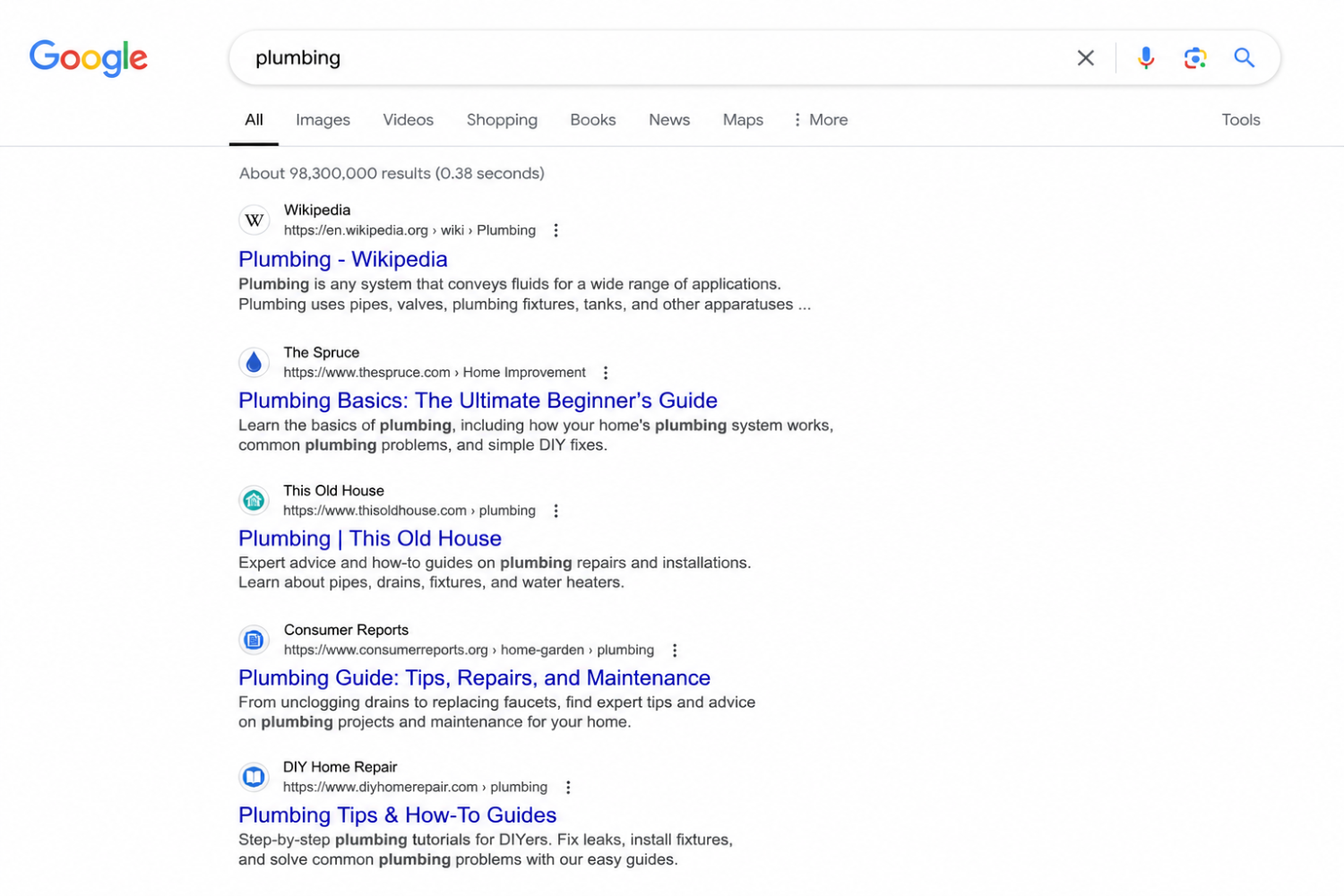
Why AI Overviews Are Stealing Your High-Intent Leads
To fix a collapsing click-through rate, you must first diagnose the exact types of searches being intercepted by Google’s interface. AI Overviews do not steal every click equally; they aggressively target specific types of user intent.
- Informational Intent: Queries like “why is my AC blowing warm air” or “how to turn off a main water valve” are completely absorbed by AI summaries. The user reads the quick, bulleted DIY steps provided by the AI and exits the search page without ever clicking a link.
- Investigative Intent: Queries like “average cost of a roof replacement” or “do I need a permit for an electrical panel upgrade” are neatly synthesized by the AI, which lists average price ranges and local regulations right in the interface.
When your website ranks #1 for these high-volume informational keywords, your impression count skyrockets. Google registers that your site was a top result for those 275,000 searches. However, because the AI instantly fulfilled the user’s intent on the search page itself, nobody actually clicks through to your site. You get all the statistical credit for being number one, but none of the financial reward.
Diagnosing Your Analytics: Impressions vs. Clicks
Fixing this problem requires a look at your actual data rather than relying on vanity metrics. If your marketing agency sends you monthly reports that only brag about “keyword visibility” and “total impressions,” they are hiding a structural flaw in your pipeline.
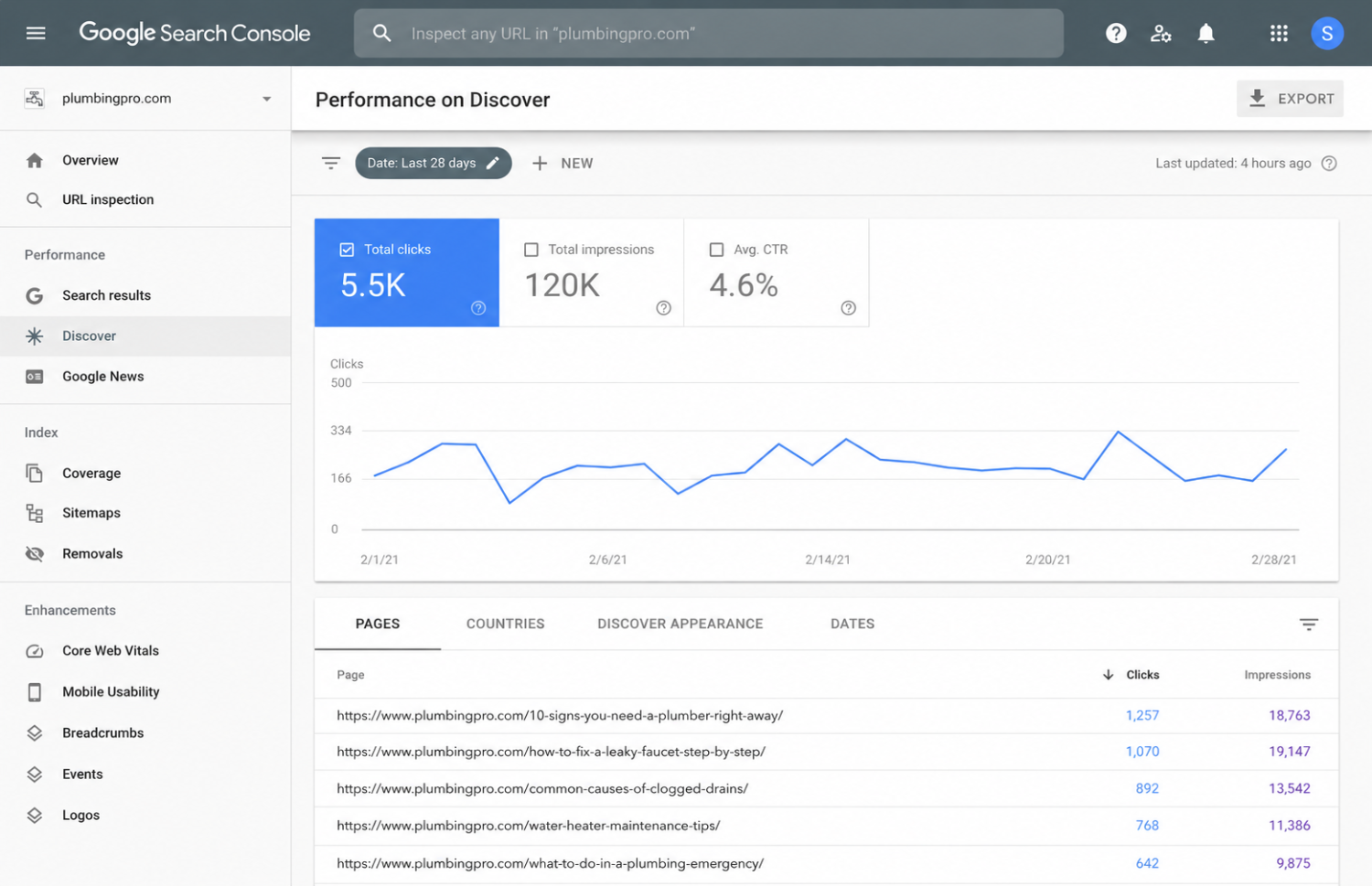
Open your Google Search Console (GSC) account and compare your total impressions against your total clicks on a page-by-page basis.
What to look for: Look specifically for pages that display thousands of impressions but single-digit clicks. This imbalance proves that the page is successfully ranking, but the target search query is trapped inside a zero-click AI snippet.
Modern business owners must undergo a psychological shift. In the current search landscape, measuring marketing success purely by raw organic traffic is a vanity exercise. The only metrics that truly matter to your bottom line are conversion actions: form submissions, direct calls, and booked appointments.
Actionable Fixes to Turn Invisible Rankings Into Phone Calls
You do not have to accept a 0.13% click-through rate as an inevitability. To reclaim your missing leads, you must adapt your digital presence to bypass or leverage the zero-click landscape.
1. Pivot to Ultra-High Transactional Keywords
Stop spending all your energy trying to rank for broad, informational phrases that AI can easily summarize. Instead, focus your content strategy on hyper-local, transactional long-tail keywords that imply immediate distress or purchase intent.
Phrases like “emergency commercial plumber open now near me” or “burst pipe repair company in [neighborhood]” cannot be solved by an AI paragraph. The user typing those phrases doesn’t want to read a summary; they need a truck sent to their house immediately.
2. Optimize for Generative Engine Optimization (GEO)
If Google is going to use AI to answer questions, you must ensure that the AI uses your business as its primary source. To become the chosen citation within the AI Overview bubble, structure your website’s content to match the exact patterns LLMs (Large Language Models) look for:
- Write clear, definitive, single-sentence answers to specific industry questions.
- Use bulleted lists, clean data tables, and explicit step-by-step formatting.
- Implement advanced schema markup to label your pricing, service areas, and licensing details explicitly for search crawlers.
3. Dominate Your Google Business Profile (GBP)
When a user bypasses your website, your Google Business Profile acts as your final line of defense. Ensure your phone number, service hours, and emergency availability are perfectly accurate and highly visible directly within the Local Map Pack.
If your GBP is optimized with a prominent, clickable “Call Now” button, users can book your services directly from the search results page without ever having to step foot on your actual website.
Frequently Asked Questions
Why does my business rank at the top of organic search results but my phone isn’t ringing?
This paradox is caused by Google’s transition into an answer engine through AI Overviews and rich snippets. Google scrapes high-quality information from top-ranking websites and presents a direct answer to the user right on the search results page. Because their question is answered instantly, consumers leave the page without ever clicking your website link, a phenomenon known as a zero-click search.
What is Generative Engine Optimization (GEO) and why is it necessary?
Generative Engine Optimization is the modern evolution of traditional SEO. Instead of just optimizing code and keywords for standard search engine bots to index your links, GEO structures your website’s data so that AI models trust your information. This increases the likelihood that Google’s AI Overviews will pull your business into conversational answers and cite you as an official source.
How can I adapt my website content to satisfy AI Overviews and get featured?
To satisfy AI-driven search criteria, you must strip away fluff and answer direct user questions in a single-sentence format within the first paragraph of a service page. Additionally, utilize clear bulleted lists, structured text tables, and clear headings. This allows conversational artificial intelligence layers to scrape, process, and attribute your content smoothly.
Reclaim Your Local Authority
Ranking #1 on Google is still a massive achievement, but it is no longer the final step in a successful marketing funnel. If your current organic strategy is generating thousands of impressions but leaving your phone lines completely silent, your business is actively losing market share to the changing layout of the internet.
Real Time Marketing has worked with home service contractors since 2016: plumbing, HVAC, roofing, electrical and other trades, nationwide, from our office in Bradenton, Florida. Agreements are month-to-month. See our answer engine optimization or book a strategy call.