

Apr 25, 2026 / Courtlyn Saxby
What Is Generative Engine Optimization (GEO) and Do Contractors Need It?
Home /

If you are a contractor running a local service business, you are likely familiar with the fundamentals of Search Engine Optimization (SEO). You know that by optimizing your website’s meta tags, building clean service layouts, and collecting customer reviews, you can climb Google’s organic rankings.
However, the technology driving internet searches has shifted. We have officially entered the era of the conversational answer engine, and traditional SEO is rapidly evolving into a new framework: Generative Engine Optimization (GEO).
This isn’t just a minor terminology shift; it represents a fundamental change in how your business is discovered online. Traditional SEO was built to help search engine crawlers find and index your website links. GEO is designed to ensure that artificial intelligence models and conversational search layers trust your corporate data enough to feature your brand inside their live summaries. For contractors looking to secure premium projects, understanding and executing GEO is no longer optional; it is a requirement for survival.

The Evolution from Keyword Filters to Predictive Intent
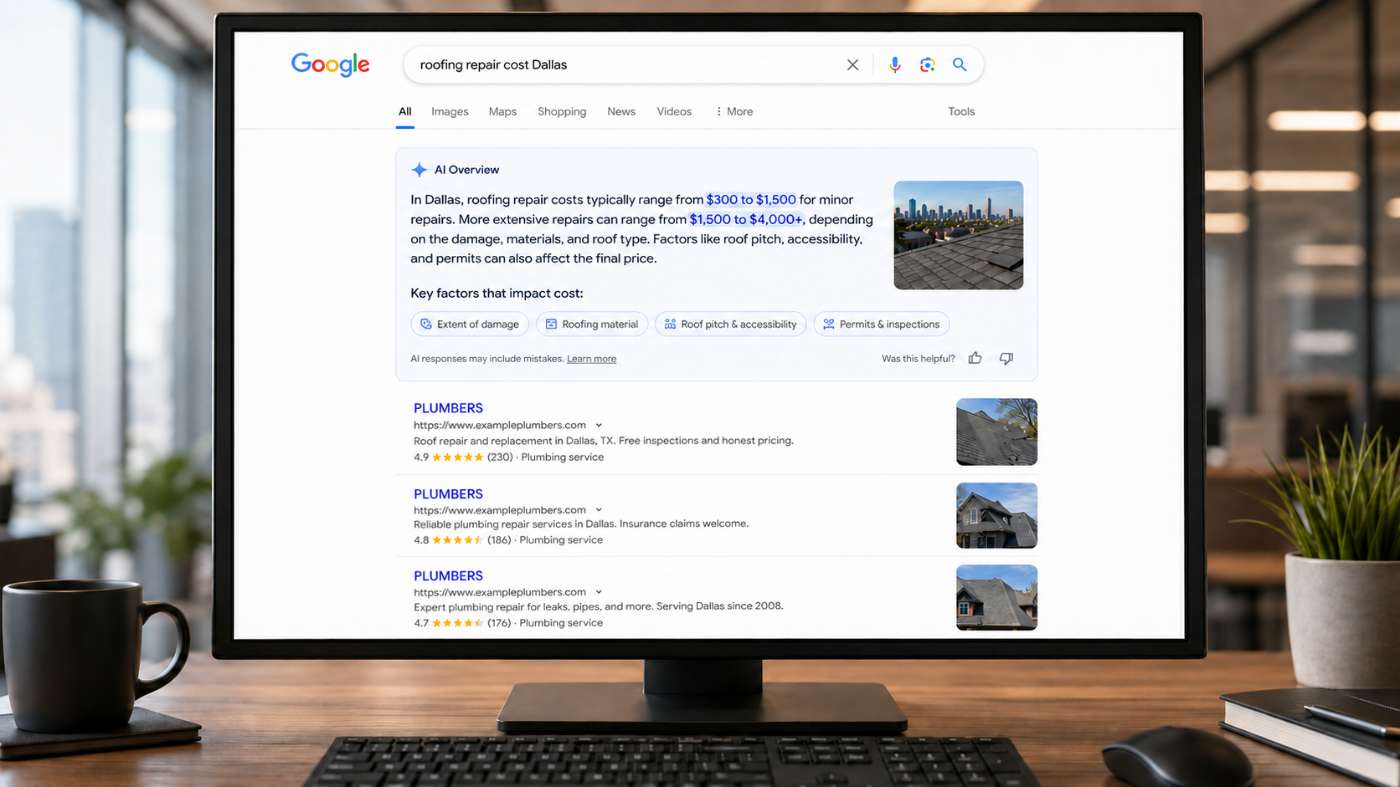
To understand why GEO is becoming essential for modern contractors, it’s important to look at how search behavior has evolved. In the past, a homeowner looking for a contractor would typically enter short keyword-based searches into Google, such as “roof repair cost Dallas”, and would type broken keyword phrases into Google, such as “kitchen contractor Tampa” or “remodeling company near me.” They would then spend time clicking through multiple website links, comparing project portfolios, and reading reviews.
Today, search behavior is increasingly conversational. Users are typing or speaking complete, complex prompts directly into search interfaces:
Traditional Keyword Approach: “roofing repair cost Dallas”
Modern GEO Conversational Approach: “I have a historic Tudor home in Dallas with minor hail damage on a slate roof. Which local roofing contractors specialize in slate, are fully insured, and have five-star reviews for historic preservation?”
A traditional SEO framework that relies on repeating basic keywords cannot answer that complex query. A generative engine needs to scan your site and find explicit verification that you satisfy every branch of that consumer’s intent. If your digital platform does not cleanly present these multi-layered facts, the engine will pass over your brand and recommend a competitor whose data is structured for conversational discovery.
The Core Pillars of a Contractor GEO Framework
Transitioning your contracting website from a standard digital brochure into a GEO-ready asset requires executing three core optimization strategies.
Absolute Technical Fact Density
Generative engines love hard numbers, technical specifications, and explicit operational data. They disregard vague marketing slogans like “We are the best local contractors.” Replace empty promotional copy with specific data points: list the precise structural material brands you install, state your exact worker health and safety certifications, outline your precise workmanship warranty lengths, and define the clear wind-resistance ratings of your building systems. This technical precision gives the algorithm concrete facts to use when recommending top-tier local service providers.
Complete Structural Readability
Large Language Models process web documentation by breaking down information into clean data clusters. If your service pages consist of long, dense blocks of text, you are creating algorithmic friction. Overhaul your content layout to prioritize maximum structural scannability:
- Organize service capabilities into clear, bold bullet paths.
- Deploy transparent side-by-side comparative text sections for material choices.
- Present local financial tiers or project timelines in clean data summaries.
Authoritative First-Party Proof
Because generative engines are trained on massive caches of scraped web text, they easily recognize boilerplate content. To prove your real-world authority to the algorithm, you must enrich your site with unique, first-party data assets. Publish deep-dive project case studies that track real jobs from start to finish. Incorporate on-site field coordinates, break down the specific engineering challenges your crew resolved, and embed verified video testimonials from local property owners. This unique, verified proof cannot be replicated by AI text scrapers, establishing your business as a high-trust regional authority.
Insulating Your Contracting Business Against Search Shifts
The contractors who adapt to GEO early will build a significant competitive advantage in their markets, while those who cling exclusively to old-school marketing methods will watch their organic leads dry up.
By restructuring your content for high fact density, organizing your layouts for easy data extraction, and consistently publishing real, verified proof of your craftsmanship, you turn your digital footprint into an indispensable source asset for modern search engines.

Frequently Asked Questions
How does GEO directly differ from traditional Search Engine Optimization?
Traditional SEO focuses on keyword placement, link building, and site speed to help search bots index and display your website link. GEO focuses on structuring your content’s layout, fact density, and authority metrics so AI engines trust your business data enough to recommend your brand in conversational answers.
Can I implement GEO tactics on my existing WordPress or custom website architecture?
Yes. GEO is primarily an upgrade to your content structure, data layout, and technical schema configurations. It does not require scrapping your existing website design, provided your current platform loads quickly and is fully responsive on mobile devices.
Why do AI search models regularly ignore standard, high-ranking directory links?
Generative search engines aim to deliver immediate, direct answers to satisfy consumer intent. Sending a user to a third-party directory page that requires additional searching and filtering adds user friction, so AI engines prefer to source facts directly from the primary service contractor’s website.
Master the Future of Trade Marketing
The search landscape is changing fast, and the businesses that refuse to adapt will quickly become invisible online. Don’t let your contracting business get left behind in the shift to AI-driven search results.
Partner with the marketing team that understands next-generation search mechanics. Contact Real Time Marketing today to discover how our custom Generative Engine Optimization frameworks can modernize your digital footprint, protect your local visibility, and keep your phone ringing.